


.svg)


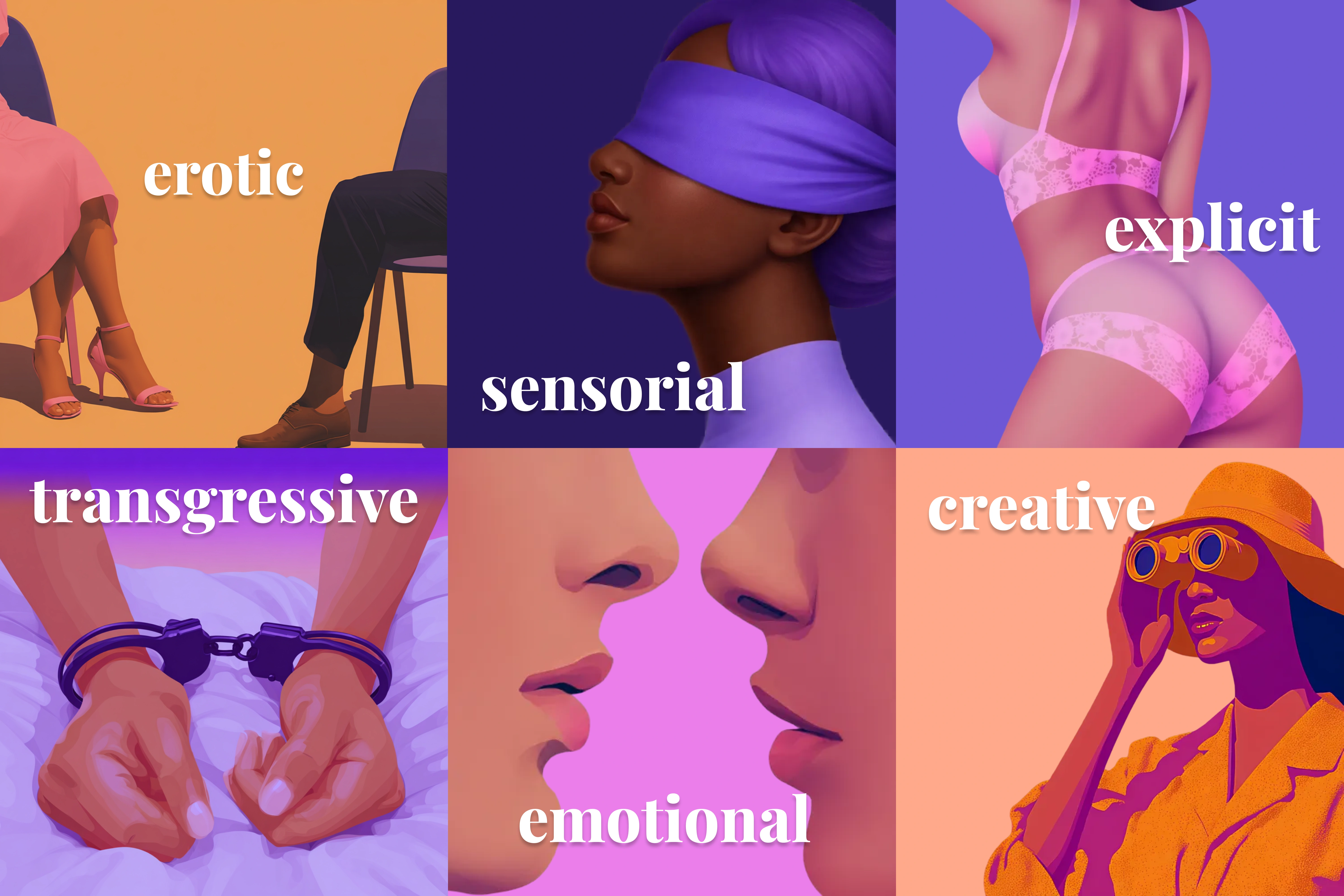
Most of us have some idea what truly turns us on, but it's not always so easy to explain it.
But what if there was a pattern you could decode?
After years of building Melba and watching what people actually choose, we've identified six distinct "Erotic Types." Think of them as your erotic fingerprint. No two people have exactly the same mix.
Understanding your type (and your partner's) can help you have more pleasure, maintain a strong connection and reduce misscommunicationin relationships.
Here's what you need to know.
What Are Erotic Types?
Erotic types are about the conditions, triggers, and atmospheres that activate your desire.
They're not about what you do in bed. They're about what gets you there in the first place.
One person might need emotional connection before their body wakes up. Another gets turned on by explicit visuals. Someone else needs the sensory atmosphere to be absolutely perfect.
None of these are better or worse. They're just different pathways to the same destination.
And here's the kicker: most people are a mix of 2 or 3 contexts. You have a primary way you get turned on, plus a couple of secondary styles that show up depending on your mood, stress level, or relationship stage.
The problem? Very few people know what their contexts actually are.
The result? We end up missing each other. Wondering why the spark feels unpredictable. Why what worked last month doesn't work now.
The good news? Once you understand your Erotic Context and your partner's, you stop playing guessing games. You start speaking each other's language.
Erotic
You're powered by anticipation and the slow burn
If this is your primary context, you don't want to jump straight to sex. You want the want itself.
The anticipation is the foreplay. You light up from the space between wanting and having. Planning ahead, flirty texts, delayed gratification. The chase, the tease, the "I can't wait to get my hands on you." Mystery, pursuit, longing. That electric moment before you kiss.
What doesn't work: Spontaneity without any build up. Going from zero to sex in three minutes. Predictability.
What we've learned: People who choose episodes like "Jeans On" and "Massage Magic" (which stretch out desire and make you ache for more). They want the story, not just the ending and lots of teasing.
What your partner should know: Don't skip the build. Send the text. Plan the date. Make them wait for it.
Emotional
Emotional intimacy unlocks your desire
If this is your primary context, your body doesn't wake up until your heart feels safe.
You need to feel seen, heard, and deeply understood first. Eye contact, vulnerability, presence. Conversations that create closeness before anything physical begins. Trust, tenderness, emotional check ins. Knowing your partner wants you, not just sex.
What doesn't work: Jumping into sex when you're feeling emotionally disconnected. Being treated like a body instead of a person. Performance without presence.
What we've learned: Connection context people gravitate toward slow, mindful experiences like "Tantric Breathwork," "The Gentle Art of Receiving," and "Beneath Her Sheets." They rarely choose episodes with power dynamics or intensity. They want presence first, pleasure second.
What your partner should know: You're not "difficult" or "complicated." You just need to feel emotionally close before physical desire kicks in. That's not a barrier. It's your pathway.
Sensorial
You need the atmosphere to be engaging
If this is your primary context, every detail matters. You're exquisitely attuned to touch, temperature, lighting, sound, smell.
Beautiful environments (candles, soft lighting, clean sheets). Textures, temperatures, full body touch. Massage, slow caresses, attention to sensation. Music, scent, aesthetics. When everything feels luxurious, your body responds.
What doesn't work: Bad lighting. Scratchy sheets. Cold hands. Rushing through touch. Environments that feel chaotic or neglected.
What we've learned: Sensory context people love massage episodes ("Massage Magic," "Her Happy Ending," "His Happy Ending"). They also tend to choose practices that involve oils, fabrics, temperature play such as “Multiple Sensations” “The Magician” and “Her Pearls”. And they almost never choose quickie style episodes. The environment has to be right or their body won't cooperate.
What your partner should know: You're not "high maintenance." Your nervous system just needs the right conditions to relax into arousal. Set the scene, and your body will respond.
Explicit
Sexual content and visuals turn you on
If this is your primary context, you're aroused by seeing, reading, or talking explicitly about sex.
Watching or reading sexual content gets your engine running. So does dirty talk and explicit language. Technical knowledge ("how to" content). Seeing bodies, explicit communication. Direct sexual stimulation without a lot of preamble.
What doesn't work: Vague hints. "Romantic" build up that avoids being explicit. Having to guess what your partner wants.
What we've learned: Sexual Stimulus people tend to choose episodes with explicit instruction like "Head Girl," "Her BJ Dream," and "Against the Wall." They want detailed technique and clear communication. They're also more likely to explore visual such as “Double Mirror Show” “Her Only Fan” and “His Appreciative Audience”. They tend skip the slow burn episodes.
What your partner should know: You're not "shallow" or "overly visual." Your arousal pathway is straightforward: show me, tell me, let's get explicit. That's valid.
Transgressive
Taboo and power dynamics light you up
If this is your primary context, you're aroused by transgression, edges, and breaking rules.
Power dynamics (dominance/submission). Role play, pushing boundaries, kink. Exploring taboos, feeling "naughty." Control (giving it or taking it). Risk, intensity, the forbidden.
What doesn't work: Sex that feels too safe, predictable, or vanilla. Being told to "tone it down." Judgment about your desires.
What we've learned: Bold context people gravitate toward episodes like "Mistress Magician," "The One with the Leash," and "Edge Control" and personified voices such as “The Mirror Speaks”.
What your partner should know: Your fantasies about power don't mean you want those dynamics in real life. Fantasy is where you play with things you'd never actually do, and that's completely healthy.
Creative
Novelty and variety keep you engaged
If this is your primary context, you need things to stay fresh. Routine is the enemy of your desire.
New positions, locations, toys, experiences. Playfulness, experimentation, spontaneity. Variety ("let's try this!"). Games, surprises, anything that breaks the script. The thrill of doing something different.
What doesn't work: Doing the same three things every time. Predictable patterns. Sex that feels like a chore or routine.
What we've learned: Explorers bounce between categories constantly. They might try "Squirting 101" one week and "Against the Wall" the next. They use more accessories than any other context. They are the ones who keep coming back for new episodes (or emailing us with their ideas).
What your partner should know: You're not "never satisfied." You just need novelty to keep your desire alive. That's how your brain is wired, and there's nothing wrong with it.
What to do with your type
Now that you know the six contexts, here's what to do:
First, identify your primary context. Which one resonates most? Which description made you think, "Oh my god, that's me"? That's likely your primary Erotic Context.
Then notice your secondaries. Most people have 2 or 3 contexts that show up. Which other ones feel familiar, even if they're not your number one?
Take the quiz. Want to know for sure? Take our 20 question Erotic Type Quiz and get your personalized profile with episode recommendations.
Compare with your partner. Once you both know your contexts, talk about where they overlap, what's totally different about how you each get turned on, what this explains about times when you've missed each other, and how you can bridge the gap.
Experiment. Try an episode that matches your partner's context, not just yours. See what it feels like to meet them in their erotic language.
How this helps
You wouldn't expect your partner to read your mind about your love language, right?
Erotic contexts work the same way.
When you understand your contexts AND your partner's contexts, you stop playing guessing games. You stop thinking, "Why aren't they in the mood?" or "Why doesn't this work anymore?"
You start speaking each other's language.
And here's the thing: your contexts can shift. Based on your relationship stage, stress levels, life circumstances, or just where you are in your cycle, your primary context might change. That's normal.
That's why we recommend retaking the quiz every few months and staying curious about what's activating your desire right now, not what used to work six months ago.
The goal isn't perfection. It's awareness.
And awareness? That's where great sex begins.
For Melba users
Everything you discover about your Erotic type feeds into your personal Melba Erotic Profile, a private living picture of what turns you and your partner on.
The more you explore, the more episodes you try, the smarter Melba gets at personalizing your experience.
Think of it as building your sexual GPS together, one discovery at a time.
So go ahead. Figure out your context. Decide if you want to share it with your partner. Try an episode that speaks your language.
Your erotic fingerprint is unique. Time to understand it.
Ready to discover your Erotic Context?
P.S. If your contexts don't overlap with your partner's? That's completely fine. Understanding the difference is what matters. You don't need to be the same. You just need to know how to meet each other where you are.

.svg)
